Aquila: The Architecture of Authority
November 10, 2026Power, inheritance and the psychology of contemporary portraiture
Simay Kıslaoğlu
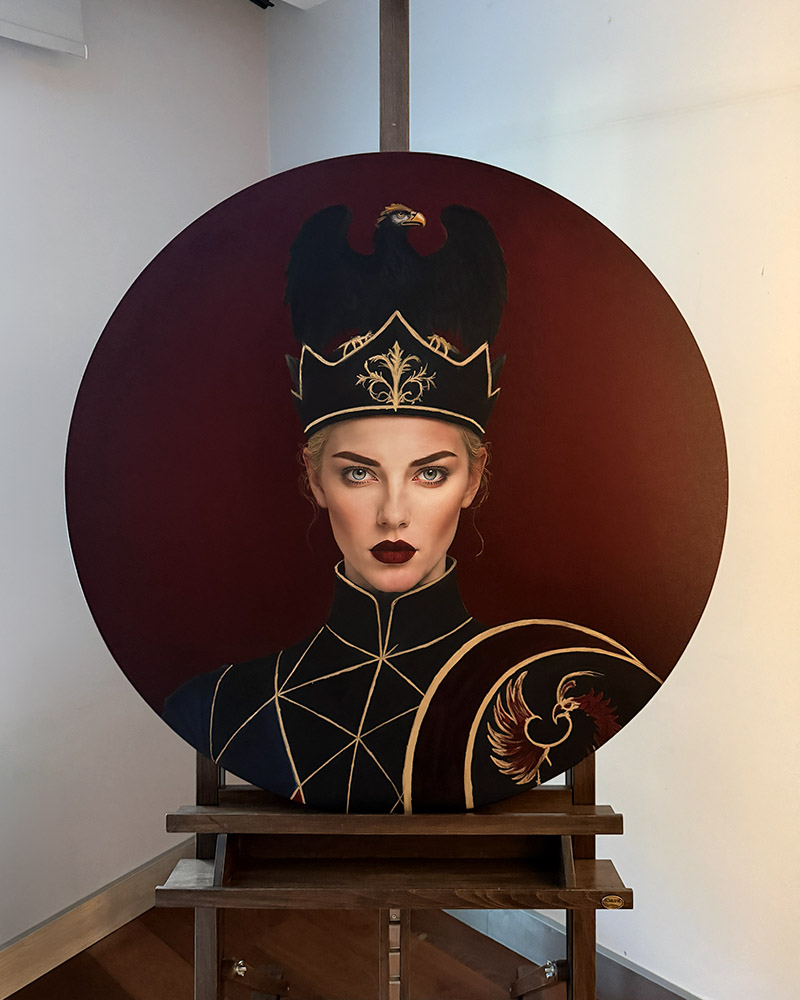
Aquila | Oil painting | 100 × 100 cm
Aquila, a contemporary oil painting by Simay Kıslaoğlu, examines the complex relationship between sovereignty, inherited authority and the construction of identity.
Drawing upon the traditions of historical portraiture, the painting presents a commanding female figure whose ceremonial presence evokes discipline, self-possession and power. Yet beneath this carefully composed exterior lies a deeper psychological enquiry into the relationship between outward appearance and inner experience.
The Eagle and the Language of Authority
Throughout art history, portraiture has employed symbolic imagery to communicate status, legitimacy and the ideals of power.
In Aquila, the eagle occupies a commanding position above the figure, accompanied by heraldic ornamentation, intricate gold detailing and a deep burgundy background.
These elements recall the visual language of aristocratic and ceremonial portraiture, in which personal identity was often inseparable from inherited structures of authority.
The circular composition reinforces the figure’s monumental presence, while the precise rendering of the face establishes a compelling contrast between the permanence suggested by historical symbolism and the individuality of the sitter.
Yet these symbols do not simply celebrate power. They invite consideration of the expectations and responsibilities attached to its representation.
Historical Portraiture and the Psychological Gaze
Central to Kıslaoğlu’s artistic practice is the relationship between outward composure and the complexities of internal experience.
The figure’s unwavering gaze introduces an intimate psychological dimension that contrasts with the rigidity of her ceremonial presentation.
Although surrounded by symbols of strength, she remains psychologically elusive.
The viewer is confronted with a paradox: a portrait that communicates authority while withholding certainty about the individual beneath its carefully constructed exterior.
The painting’s restrained modelling, meticulous facial detail and controlled transitions of light strengthen this tension, bringing a sense of human vulnerability into an otherwise formal image.
Identity Beyond Inheritance
In Aquila, identity is neither entirely inherited nor permanently established.
Rather, it emerges through an ongoing negotiation between personal agency, historical structures and external expectations.
The painting considers how individuals inhabit roles that offer both definition and limitation, and how the apparent stability of those roles may conceal a more complex internal reality.
Strength and fragility, sovereignty and responsibility, self-definition and social expectation are not presented as opposing conditions. Instead, they coexist within the evolving architecture of the self.
Through the visual conventions of historical portraiture, Kıslaoğlu reframes questions of authority as questions of identity.
Ultimately, Aquila proposes that sovereignty is not merely the possession of power or the inheritance of status, but the continuing effort to define oneself beyond the structures through which one is perceived.
A portrait of authority becomes a meditation on the freedom to become.