Frieze Week London 2026
October 11, 2026A Portrait Should Not Promise Permanence
Historically, portraiture was built to resist change. A painted face carried status, lineage, beauty and authority beyond the instability of an individual life. The person might age, lose power or disappear, but the portrait continued to insist on permanence.
I am drawn to that authority, but I do not entirely trust it.
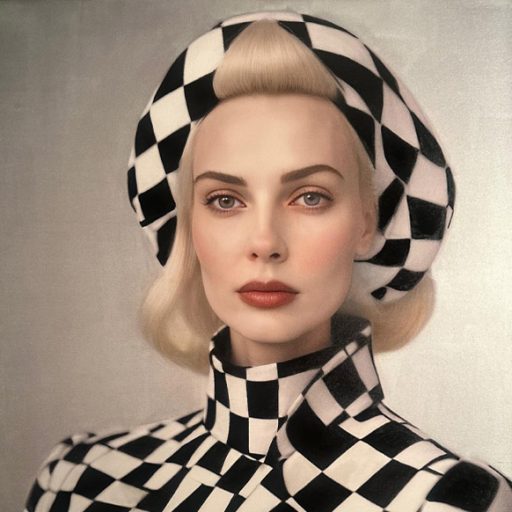
The women in my paintings are not presented as fixed identities. They are imagined figures, although fragments of my own appearance often enter their faces. I do not consider them conventional self-portraits. Each one holds a different stage, pressure or possibility within an evolving self.
Motherhood made this instability impossible for me to ignore. Becoming responsible for another life does not erase the person one was before, but it changes the architecture around her. Ambition, vulnerability, independence and care begin to occupy the same psychological space. Identity does not move neatly from one version to another. Its earlier forms remain present.
This is why geometry appears in my work. The grid promises structure. The chessboard offers rules, positions and possible movements. Yet no system can fully explain the figure placed inside it. Her outward composure may be convincing, but it is never complete evidence of what she has experienced.
Oil paint allows me to build that uncertainty slowly. A face develops through layers, corrections and concealed decisions. What appears stable on the surface may have been revised many times underneath. In this sense, the material behaves like identity itself: the final image contains versions that are no longer visible but have not entirely disappeared.
My use of historical portraiture is therefore not nostalgic. I am interested in what happens when a visual language designed to declare permanence is asked to hold psychological change. Can a figure possess authority without pretending to be resolved? Can stillness represent an active state of becoming?
I believe a contemporary portrait should leave room for that incompleteness.
The object may endure, but the identity it contains should remain alive. I do not want my paintings to tell viewers who a woman definitively is. I want them to hold the more difficult and human question of who she is still becoming.